
The AI Shortcut Is Hollowing Out the Professions
“AI will not replace professionals, but AI-powered professionals will.” When Steve Hasker, President & CEO of Thomson Reuters, shared this outlook, it highlighted a profound transition sweeping across professional services. But as organization-wide AI adoption in professional services nearly doubles to 40% in 2026 (up from 22% in 2025), a deeper question confronts engineering firms, accounting practices, and legal teams:
If AI handles the foundation of professional work, how do junior professionals build the domain context required to become the senior experts who audit the AI?
Part 1: What does the data say?
1️⃣ Efficiency Up, Judgment Down
The data is undeniable, and it creates a direct retention paradox for professional bodies.
While macro-level automation is a win, localized friction is occurring where critical intuition is formed. Recent global field studies track a dangerous divergence:
- The Leveling Effect: Less-experienced and junior workers see the biggest immediate productivity gains, increasing output by 27% to 39% (MIT Sloan/MS).
- The Senior Plateau: Seniors with foundational mastery only see a modest 8% to 13% bump from the exact same tools.
The problem? While productivity soars, professional judgment is crashing. By automating entry-level execution, we are allowing juniors to skip the “grunt work” where they actually build the intuition, risk awareness, and critical thinking required to spot when that AI makes a complex, high-stakes error.
2️⃣ 🌐 The Universal Problem: The Training Ground is Shrinking
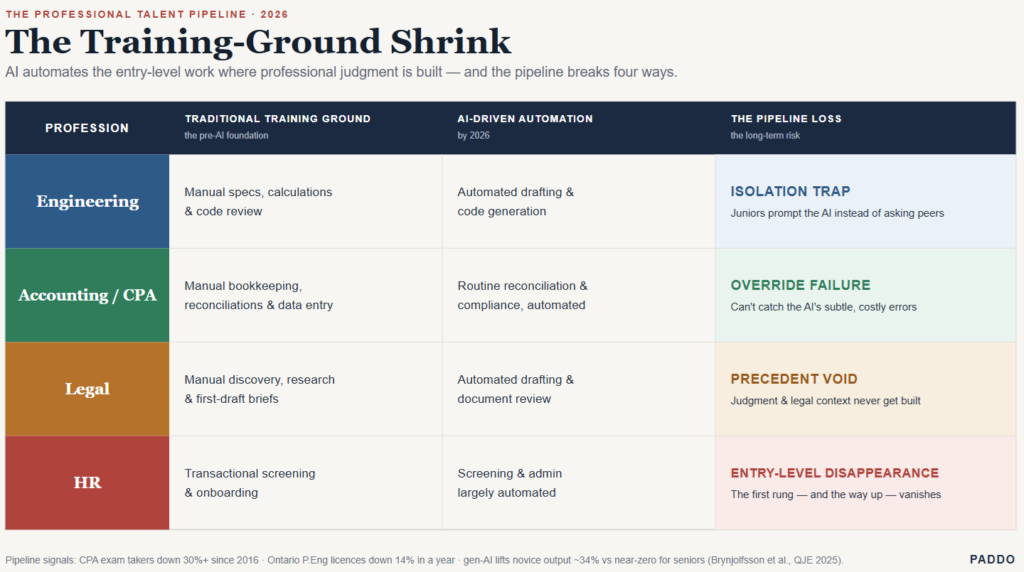
This isn’t just an engineering issue; it’s a systemic emergency hitting every professional association. When we eliminate the training grounds today, we will have no senior experts capable of auditing the AI ten years from now.
The visual below summarizes the critical data from 2025/2026 reports, showing how automated entry-level roles across four key domains (Engineering, CPA, Legal, HR) are creating an environment of professional isolation.
3️⃣ Cross-Industry Friction and the Licensure Integrity Crisis
The 2026 Thomson Reuters Report highlights that organization-wide AI adoption has doubled to 40%, driving a structural shift from a talent pyramid to a diamond model that squeezes entry-level roles. However, because AI hits a volatile 11% error rate on complex compliance tasks, expert human auditing remains vital to protect asset quality.
This environment poses an immediate threat to licensure integrity.
A P.Eng, CPA, or JD does not certify fast output; it certifies public-protection judgment. The traditional supervised pathway is the sole operational crucible for this judgment. If it hollows out into isolated prompt engineering, the underlying value of the professional credential erodes.
Part 2: The Solutions
1️⃣ Why Human Connection Is the Key
Decades of research on how professionals actually develop point to the same answer. The Center for Creative Leadership’s widely-cited 70-20-10 finding holds that about 70% of professional learning comes from hands-on experience, 20% from other people — mentoring, feedback, watching a senior work — and only 10% from formal courses. In other words, roughly 90% of real expertise is built through doing and through relationships — the two things the AI shortcut quietly removes. When a junior asks a prompt instead of a senior, they skip the 20%. When AI does the task, they skip the 70%. No amount of formal CPD backfills that.
And the relationship itself is measurable. A meta-analysis of 43 studies (Allen et al.) found mentored professionals are promoted more, earn more, report higher career satisfaction, and are far more likely to stay in the field. The classic Sun Microsystems study put hard numbers on it: mentees were promoted 5x more often and retained at 72% vs. 49% for non-participants. Mentorship doesn’t just transfer skill — it tethers people to a profession they might otherwise abandon.
2️⃣ 10-Year Down the Road
Roughly 80% of professional knowledge is tacit (MIT) — the unwritten judgment that lives in experienced people and transfers only by working alongside them. As today’s seniors retire and tomorrow’s juniors are trained mostly by prompts, that knowledge doesn’t get passed down. It evaporates. The consequences, profession by profession:
- Engineering: fewer engineers ever develop the judgment to seal a design — a public-safety problem, not just an HR one.
- Accounting & law: no senior practitioners trained deeply enough to catch what the AI gets confidently wrong.
- Across the board: a “missing middle” — a generation that can operate AI but can’t supervise it, arriving exactly when the experts who could are already gone.
That is what “no one left to audit the AI” actually looks like — and it’s a decade out, not a lifetime.
3️⃣ The Fix can be simple
The fix isn’t more technology. It’s rebuilding the 90% — deliberately, through structured peer and senior mentorship. Let AI handle the data; keep your people on the judgment.
Metric Focus | Core Benchmark Data | Independent Data Source |
Talent Retention | 72% retention for mentees vs. 49% for non-participants (23-point stability gap) | Gartner / Sun Microsystems Landmark Study |
Workplace Loyalty | Millennials intending to stay 5+ years are twice as likely to have a mentor (68% vs 32%) | Deloitte Global Millennial Survey |
Role Satisfaction | Professionals with mentors report significantly higher job satisfaction (91% vs 79%) | CNBC / SurveyMonkey Workplace Index |
Career Velocity | Mentees are promoted 5 times more often than non-participating peers | Wharton / University of Pennsylvania |