

Ontario Needs 1 Million University Graduates by 2035. Here's What It Means for Professional Associations.
A new report from Stokes Economics, commissioned by the Council of Ontario Universities, projects that Ontario will need more than one million new university-educated workers between 2026 and 2035 — roughly 100,500 every single year. The coverage has framed it as a story about universities. But the more useful question, especially if you run a professional association or a regulatory college, is what happens after the degree: who carries these graduates from “hired” to “fully developed professional”?
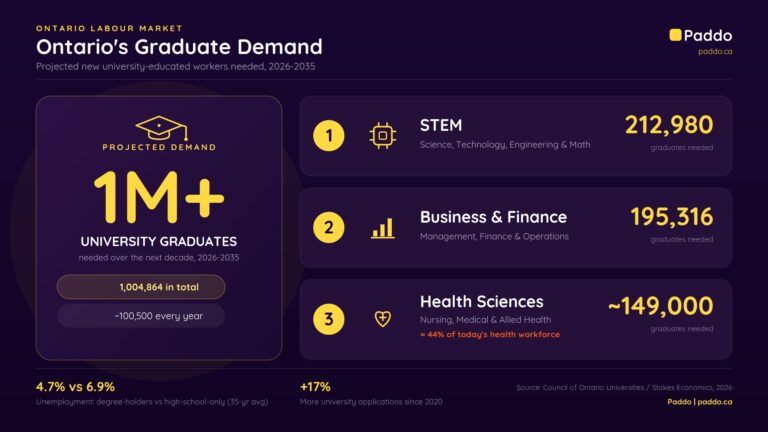
The scale of Ontario's talent shortage
1️⃣ The numbers, briefly
The projection covers all occupations that typically require or prefer a university education — about 1,004,864 workers over the decade. Three fields account for the lion’s share of the demand:
- STEM — 212,980 graduates
- Business, Finance & Administration — 195,316 graduates
- Health Sciences — roughly 149,000 graduates, equivalent to about 44% of today’s entire health workforce
Those three streams alone work out to about 56,000 graduates a year (the ~100,500 figure spans every university-educated field, not just these three — worth keeping straight, since the two numbers get conflated a lot).
One detail the headlines skip: the forecast isn’t driven only by economic growth. A large share of it is workforce replacement — backfilling the experienced people who retire or leave the labour force over the next ten years. Hold onto that, because it changes how you should read the AI question.
2️⃣ AI isn't shrinking this demand — it's reshaping it
The reflexive take on any “we need a million workers” story is: won’t AI just absorb these jobs? It’s a fair question, and the honest answer is more interesting than a yes or no.
Start with that replacement point. A big chunk of the million isn’t new headcount — it’s filling roles vacated by retirement. AI doesn’t retire your senior engineer or your veteran nurse on your behalf, and it doesn’t inherit the credential, license, or institutional knowledge that walked out the door. That demand is demographic, and demographics don’t automate.
Then look at which fields top the list — they’re precisely the ones where AI tends to complement rather than replace:
- Health sciences is physical, regulated, and high-trust. AI reads the scan and drafts the chart; a human still performs the procedure and is accountable for it. And the demand here is growing for a reason no model can fix — an aging population needs more care, full stop.
- STEM is a productivity story, not a substitution one. AI makes engineers and scientists faster, but someone still has to build the physical thing, run the experiment, validate the output, and take professional responsibility for it. An engineering seal is held by a person, not a model.
There’s also a counterintuitive economic effect worth naming: when a tool makes skilled work cheaper and faster, you often get more of that work, not less, because more projects suddenly become worth doing. Where demand for the output runs deep — healthcare, infrastructure, clean energy — productivity gains tend to expand the work rather than cut the team.
None of this means AI is irrelevant to the forecast. University of Toronto higher-education professor Glen Jones, quoted in the coverage, flags AI as one of three “wildcards” — alongside immigration and economic instability — that could move these numbers in either direction. And the place to actually watch for pressure isn’t the aggregate; it’s the entry level and the routine cognitive roles, the exact rungs new graduates stand on. A field can keep growing while the on-ramp for a 22-year-old gets narrower.
3️⃣ Where associations and regulatory colleges come in
Here’s the line in the report I keep coming back to. On health care, it notes that the ability to “educate, recruit, and integrate” the next generation of professionals will be essential. Integrate is the operative word — and it’s exactly the part a university degree doesn’t finish.
A degree gets someone in the door. Professional associations and regulatory colleges carry them the rest of the way: credentialing and continuing competence, mentorship from people who’ve done the job, a peer community to belong to, and pathways to the next role. As AI reshapes what each profession actually requires day to day, that development-and-connection layer doesn’t become less valuable. It becomes more valuable, because the half-life of a given skill keeps shrinking and someone has to help members keep up.
Concretely, that’s the work member organizations are built for:
- pairing newer members with experienced ones through structured mentorship matching
- giving professionals a place to ask questions and belong via a peer community
- connecting members to opportunities with a member job board
- bringing the next cohort up to speed through onboarding and learning
- reinforcing participation and contribution with recognition
- and understanding it all through real-time engagement insights
4️⃣ The capacity challenge cuts both ways
The report’s authors warn that funding, policy, and enrollment caps have to expand or existing shortages will intensify — and Ontario has started to move, recently committing to tens of thousands of new seats in high-demand programs like health care and STEM. That’s the supply side.
For associations and colleges, capacity is also an engagement problem. A membership that’s growing quickly and changing faster is harder to onboard, develop, and retain — and a credential that members don’t stay engaged with loses its pull. Meeting the moment isn’t only about producing more graduates; it’s about keeping a fast-moving profession connected, current, and supported across a whole career.
That’s the problem Paddo was built to solve — a member engagement platform purpose-built for professional associations and regulatory colleges. If a million-graduate decade is coming, the organizations that develop and retain those professionals are going to matter more than ever.